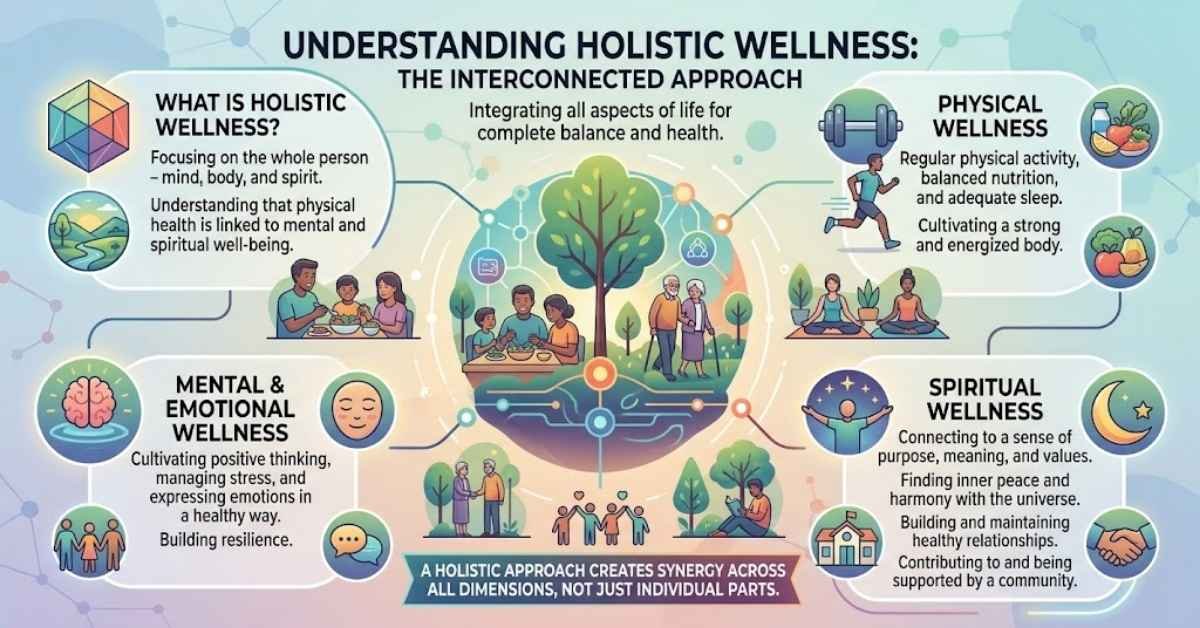
Holistic meaning refers to considering a whole person, system, or situation rather than focusing on just one part. A holistic approach looks at how different factors connect and influence one another. For example, a holistic approach to health considers not only physical symptoms but also sleep, stress, lifestyle, and emotional well-being.
You may encounter the word holistic in conversations about medicine, mental health, education, personal development, or business. Although its meaning varies slightly by context, the central idea remains the same: understand the bigger picture before making a judgment or decision.
What Does Holistic Mean?
Holistic is an adjective that describes an approach focused on the whole rather than isolated parts. It recognizes that the different elements of a person, problem, or system can affect one another. Cambridge Dictionary defines the term in relation to treating or dealing with something as a whole rather than considering only parts of it.
In simple terms, holistic means looking at the complete picture. Instead of asking only what is happening, you also consider why it might be happening and what other factors could be involved.
Imagine a student whose grades suddenly drop. A narrow approach might focus only on the student’s test scores. A holistic approach would also consider sleep, workload, learning difficulties, stress, family circumstances, and the learning environment. Those factors may help explain the problem and identify a more useful solution.
The word does not automatically mean natural, spiritual, or alternative. It describes a way of understanding something. You can take a holistic approach to a business, a classroom, a relationship, or a medical concern without using alternative therapies or adopting a particular belief system.
Holistic Meaning in Simple Words
In everyday language, holistic means considering all the important parts together.
For example, if you want to improve your well-being, you might consider your physical health, emotional needs, sleep, relationships, and daily habits. You wouldn’t assume that changing one factor will solve every problem.
Similarly, a business owner might look beyond monthly sales and consider customer satisfaction, employee workload, product quality, operating costs, and long-term growth.
The goal is not to examine every possible detail. It is to recognize the factors that matter and understand how they work together.
How Do You Pronounce Holistic?
In American English, holistic is commonly pronounced hoh-LIS-tik, with the stress on the second syllable. Cambridge Dictionary provides an American pronunciation recording and phonetic transcription.
The spelling wholistic is also sometimes used, but holistic is the standard form in most contemporary writing.
Where Does the Word Holistic Come From?
The word holistic comes from holism, a term associated with the idea that a whole can have characteristics that cannot be understood simply by examining its separate parts. The word holism was formed from the Greek root holos, meaning “whole.”
South African statesman and philosopher Jan Smuts helped develop the modern concept of holism in his 1926 book Holism and Evolution. His work explored how wholes emerge through the relationships and organization of their parts. Dictionary.com explains the word’s history and development.
Over time, the term became common in fields such as psychology, education, ecology, and medicine. Today, it is also widely used in business strategy, personal development, and discussions about overall well-being.
Although these applications differ, they share the same underlying principle: understanding the parts often requires understanding the larger system they belong to.
What Is a Holistic Approach?
A holistic approach considers the different factors that contribute to a situation before deciding how to respond. It looks for connections, patterns, and possible causes rather than treating every issue as an isolated event.
This doesn’t mean ignoring details or avoiding specialized analysis. Sometimes you need to study individual parts closely. Holistic thinking adds another step by asking how those parts relate to the whole.
Example of a Holistic Approach
Consider a company whose customer satisfaction scores have fallen. Management could respond by telling employees to answer support requests faster. That might help, but it may not solve the underlying problem.
A holistic review could examine product defects, confusing instructions, delivery delays, staffing levels, customer expectations, and the support process itself.
The review might reveal that customers are contacting support because the product instructions are unclear. Improving those instructions could reduce complaints, shorten support queues, and improve customer satisfaction simultaneously.
This example shows why holistic thinking can be useful: one problem may have several connected causes, and one well-chosen change can improve multiple outcomes.
What Are the Main Principles of Holistic Thinking?
A holistic approach usually involves several related habits.
First, it considers the relevant parts of a situation rather than concentrating on the most obvious symptom. Second, it looks for relationships between those parts. Third, it considers the wider context, including environmental, social, or organizational influences. Finally, it evaluates how a proposed solution might affect the entire system.
These principles do not guarantee a correct conclusion. They provide a broader framework for asking better questions and avoiding decisions based on incomplete information.
What Does Holistic Mean in Health and Medicine?
In health care, holistic refers to considering the patient as a whole person rather than concentrating exclusively on an isolated disease, symptom, or body part. Depending on the situation, this may include physical health, mental and emotional well-being, lifestyle, social support, and environmental circumstances.
For example, someone experiencing ongoing fatigue may need an appropriate medical assessment alongside a discussion of sleep, medication, nutrition, stress, and other relevant factors. A clinician should use the person’s history, examination, and appropriate testing to determine what needs attention.
The idea is not to replace medical diagnosis with general lifestyle advice. It is to understand the patient more completely while still using appropriate clinical methods.
The National Center for Complementary and Integrative Health describes whole-person health as an approach that considers interconnected biological, behavioral, social, and environmental factors.
What Is Holistic Medicine?
Holistic medicine refers to approaches to health care that consider the person’s overall well-being and the relationships between different aspects of health. Depending on the practitioner, care may include conventional medical treatment, lifestyle guidance, or selected complementary therapies.
Some practitioners may discuss nutrition, physical activity, sleep, stress management, and social support alongside treatment for a specific condition. Others may incorporate therapies such as massage or acupuncture where appropriate.
However, the term holistic medicine does not establish that a treatment is safe or effective. Different therapies have different levels of scientific evidence, and claims should be evaluated individually.
A responsible approach involves asking what a treatment is intended to do, what evidence supports it, what risks it carries, and whether it could interfere with existing treatment.
Holistic Health: Mind, Body, and Lifestyle
Holistic health emphasizes that physical, psychological, behavioral, and social factors can interact. A person’s sleep habits may affect concentration, for example, while chronic stress may influence daily routines and the ability to maintain healthy habits.
This perspective can encourage people to consider several aspects of their well-being rather than expecting one change to solve everything.
For example, someone trying to improve their energy might discuss persistent symptoms with a health professional, review their sleep routine, consider their activity level, and examine whether stress or medication could be contributing. The appropriate plan depends on the individual’s circumstances.
A holistic view does not mean every health problem has a lifestyle cause. It means relevant influences should be considered without overlooking medical conditions that require specific treatment.
Holistic vs. Integrative vs. Alternative Medicine
These terms are related, but they do not mean the same thing.
| Term | Meaning | Key distinction |
|---|---|---|
| Holistic medicine | Considers the patient as a whole person | Describes a broad approach to care |
| Integrative medicine | Combines conventional medicine with selected complementary approaches | Emphasizes coordination and evidence-informed treatment |
| Alternative medicine | Describes practices used instead of conventional medical treatment | The treatment replaces rather than supplements standard care |
| Conventional medicine | Uses established medical practices, including appropriate diagnosis, medication, procedures, and other treatments | Often focuses on specific conditions while also allowing whole-person assessment |
The distinctions matter because a holistic approach can include conventional medical treatment. It does not automatically require herbal remedies, supplements, or other alternative therapies.
Integrative medicine, by contrast, specifically involves combining conventional care with selected complementary approaches. Cleveland Clinic explains this distinction in its guide to integrative medicine.
Before trying a complementary treatment, check its evidence, potential side effects, and interactions with medications. Do not stop prescribed treatment or delay urgent medical care simply because an alternative approach is described as holistic.
Holistic Meaning in Everyday Life, Education, and Business
The word holistic is not limited to health. It can describe any approach that considers the wider context and the relationships between important factors.
Holistic Approach to Life
A holistic approach to life means considering how your habits, relationships, responsibilities, values, and well-being fit together. Instead of judging your life by one measure, such as income or productivity, you consider whether different areas support the kind of life you want.
For example, accepting a promotion might improve your income but also increase your working hours. A holistic decision would consider the financial benefits alongside your health, family responsibilities, career goals, and personal time.
This does not mean choosing comfort over ambition. It means making decisions with a fuller understanding of their potential effects.
Holistic Education
Holistic education considers students’ academic learning alongside relevant aspects of their social, emotional, physical, and personal development.
A teacher using this approach may consider not only whether a student understands a lesson but also whether the classroom environment supports participation, whether the teaching method suits the learning objective, and whether the student needs additional help.
For instance, a child who struggles with reading may benefit from targeted instruction, but the teacher might also examine attendance, access to reading materials, language needs, and confidence in the classroom.
The goal is to understand what supports learning rather than assuming that a test score tells the whole story.
Holistic Business Strategy
A holistic business strategy considers how different departments, processes, and decisions affect the organization’s overall performance.
A marketing campaign, for example, may generate more sales but also increase customer service demands. If the company cannot fulfill orders promptly, the short-term gain may create long-term problems.
A holistic strategy evaluates marketing, operations, customer experience, finances, staffing, and business goals together. This helps decision-makers identify trade-offs and avoid improving one metric at the expense of the entire organization.
Holistic Psychology
Holistic psychology generally refers to perspectives that consider a person’s experiences and functioning in a broader context. Depending on the approach, this may include thoughts, emotions, behavior, relationships, environment, and physical well-being.
For example, understanding a person’s anxiety may involve considering their thoughts, current stressors, social circumstances, and relevant health factors. The appropriate assessment and treatment still depend on the individual’s needs and the evidence supporting available options.
The term can be used broadly, so it is helpful to examine the specific psychological approach being discussed rather than assuming that all practitioners mean the same thing.
Holistic Synonyms and Antonyms
The best synonym for holistic depends on the sentence. Some words emphasize completeness, while others emphasize relationships or broad coverage.
Common Synonyms for Holistic
| Synonym | How it differs |
|---|---|
| Comprehensive | Covers many or all relevant aspects of a subject |
| Whole-person | Emphasizes the complete individual, especially in health care |
| All-encompassing | Suggests broad coverage of a subject or situation |
| Integrated | Emphasizes how separate parts work together |
| System-wide | Focuses on an entire system rather than one component |
| Broad-based | Includes a wide range of factors or perspectives |
| Complete | Suggests that nothing important is missing |
These words overlap with holistic, but they are not perfect substitutes in every sentence. For example, a comprehensive report may cover every section of a subject without examining how those sections interact. A holistic report would ideally consider both coverage and relationships.
What Is the Opposite of Holistic?
There is no single antonym that fits every context. Depending on the sentence, possible opposites include fragmented, narrow, piecemeal, or reductionist.
A fragmented approach treats parts as disconnected. A narrow approach considers only a limited aspect of a problem. A reductionist approach seeks to explain a complex phenomenon by examining its constituent parts or more basic mechanisms.
Reductionism can be useful in science, so it is not inherently a mistake. The limitation arises when an explanation of individual components is treated as a complete explanation of a system that depends on their interactions.
LEARN MORE: Legacy Meaning
Holistic in a Sentence: Examples and Common Usage
Seeing the word in context makes its meaning easier to understand.
- Health: “The doctor took a holistic approach by considering her symptoms, sleep, stress, and medical history.”
- Education: “The school adopted a holistic approach to student development.”
- Business: “The company needed a holistic strategy that connected marketing, sales, and customer service.”
- Personal development: “He took a holistic view of success by considering his health, relationships, and career.”
- Environmental planning: “The city used a holistic approach to examine transportation, housing, and air quality.”
- Problem-solving: “A holistic analysis revealed that several small issues were contributing to the larger problem.”
In each example, holistic signals that the subject should be understood in a broader context.
Common Mistakes When Using Holistic
One common mistake is using holistic to mean simply “natural.” A natural product may be part of a holistic health plan, but the word itself does not describe whether something is natural or artificial.
Another mistake is assuming that holistic thinking requires considering absolutely everything. In practice, it means identifying the relevant factors and their relationships. No useful analysis can examine every possible influence in equal detail.
Finally, holistic does not mean rejecting specialized knowledge. Experts can study individual parts of a system while also considering how those parts interact. The two approaches can complement each other.
Frequently Asked Questions About Holistic Meaning
What does holistic mean in one word?
Whole is the closest simple answer. More precisely, holistic means considering the whole rather than treating its parts as completely separate.
What does holistic mean when describing a person?
Describing someone as holistic may mean they consider different aspects of life or view a person as more than a single trait, role, or problem. The exact meaning depends on the context.
Does holistic mean natural?
No. Holistic describes a whole-person or whole-system perspective. Natural products and traditional remedies may appear in some holistic practices, but they are not required by the definition.
Is holistic the same as comprehensive?
Not exactly. Comprehensive means covering the relevant parts of a subject. Holistic emphasizes understanding the whole and how its parts interact. An approach can be comprehensive without fully examining those relationships.
What does holistic wellness mean?
Holistic wellness refers to considering multiple connected aspects of well-being, such as physical health, emotional health, social relationships, lifestyle, and environment. It does not mean that one particular routine or therapy can guarantee good health.
Is holistic medicine scientifically proven?
There is no single scientific verdict for every practice described as holistic medicine. Some components, such as appropriate exercise, nutrition guidance, and evidence-based psychological care, have established uses. Other therapies have limited or mixed evidence. Each treatment should be assessed on its own evidence, risks, and suitability.
What is an example of holistic thinking?
A company investigating falling sales might examine product quality, pricing, customer needs, marketing, and service rather than blaming its sales team alone. The approach considers how multiple factors could contribute to the result.
What is a holistic approach to education?
It considers academic learning alongside relevant social, emotional, physical, and personal-development needs. The aim is to understand the learner’s broader circumstances and support effective learning.
Final Thoughts
The meaning of holistic comes down to seeing the bigger picture. Whether you’re discussing health, education, business, or everyday life, a holistic approach considers the important parts of a situation and how they influence one another.
It does not mean ignoring details, rejecting conventional medicine, or believing that natural treatments are always better. Instead, it encourages a more complete understanding before reaching a conclusion.
The central lesson is simple: when different parts of a situation affect one another, understanding those connections can lead to better decisions.






1 thought on “Holistic Meaning: Definition, Examples, and How It Works”