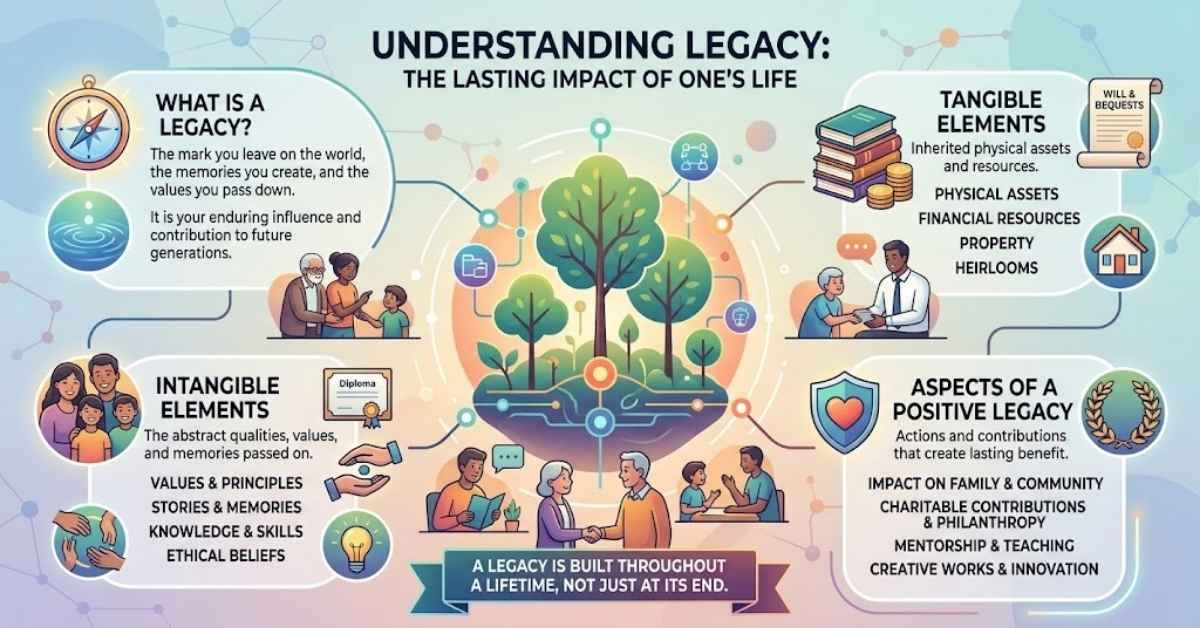
Legacy meaning refers to something passed down from the past, such as money, property, values, achievements, or lasting effects. A legacy can be an inheritance left in a will, the influence a person has on others, or the consequences of an event that continue over time. In technology, legacy describes older systems or software that remain in use.
The word has several meanings, but they share one central idea: something from the past continues to matter in the present. Understanding the context helps you know exactly what someone means when they use it.
What Does Legacy Mean in Simple Words?
In simple words, a legacy is something you leave behind or receive from the past. It might be money from a relative, a tradition passed down through your family, or an achievement that people remember long after its creator is gone.
For example, a grandmother might leave her grandchildren a house as a financial legacy. A teacher might leave a legacy by inspiring generations of students. A historical event might leave a legacy of social change or conflict. Each example describes something that continues beyond its original moment.
The Main Meanings of Legacy
The meaning of legacy depends on the subject being discussed. Dictionaries commonly describe it as property left by a will or something handed down from an earlier person, time, or event. The word is also used as an adjective, especially when describing older technology. Cambridge Dictionary and Dictionary.com explain these different uses.
1. Legacy as Money or Property
In legal and financial contexts, a legacy is money or property given to someone through a will. The person receiving it benefits from something the deceased person chose to leave behind. A legacy may include money, personal belongings, or other property, depending on the circumstances and applicable law.
For example, if an aunt leaves her nephew $10,000 in her will, that gift can be called a legacy. This meaning is close to inheritance or bequest, although the precise legal use can depend on the jurisdiction and the wording of the will.
2. Legacy as a Lasting Influence
In everyday conversation, legacy often describes the lasting effect a person has on other people or the world. That influence may come from achievements, leadership, kindness, creativity, teaching, or service. It does not have to involve money or property.
For example, a doctor who trains young physicians and improves care in a community may leave a meaningful legacy. Their influence continues through the people they teach and the work those people do later. In this sense, a legacy is less about what someone owns and more about what continues because of their actions.
3. Legacy as the Result of Past Events
A legacy can also be an outcome that remains after an event, decision, or historical period has ended. These effects may be helpful, harmful, or a mixture of both. The phrase legacy of the past often refers to consequences that continue to shape society today.
For example, a war may leave a legacy of grief, damaged communities, and political tension. A public investment program might leave a legacy of better roads, schools, or infrastructure. The word does not automatically suggest something good; the surrounding sentence determines whether the legacy is positive or negative.
4. Legacy in Technology
In technology, legacy describes older computer systems, software, hardware, or code that remain in use after newer options become available. A legacy system may still perform important tasks, even if it is expensive to maintain or difficult to connect with modern tools.
For example, a company might rely on an older database to process customer records because replacing it could disrupt daily operations. That database may be called a legacy system. The term does not always mean that a system is completely broken or useless; it often signals that the technology was built for an earlier environment. IBM and TechTarget explain the practical challenges of maintaining legacy code and systems in their technical guides.
5. Legacy in US College Admissions
In the United States, legacy can refer to a college applicant who has a family connection to someone who attended the same institution. The exact relationship that qualifies—such as a parent or grandparent—depends on the college’s policy.
For example, a university may describe the child of an alumnus as a legacy applicant. This is a specialized meaning of the word, not its general definition. It is best to check the specific institution’s admissions policy rather than assume every college uses the same criteria.
What Does It Mean to Leave a Legacy?
To leave a legacy means to create something whose influence continues after you have moved on or are no longer alive. People often use the phrase when talking about a person’s values, contributions, work, or impact on future generations.
A legacy does not have to be famous or extraordinary. A parent who teaches children to be honest, a volunteer who supports a local community, or a mentor who helps others build confidence can all leave lasting influences. The key is that something meaningful continues because of what the person did.
You can think about a personal legacy by asking three questions: What do I want people to remember? Who benefits from my actions today? What can continue after my direct involvement ends? These questions turn the idea of legacy into something practical rather than simply a word associated with famous people.
Can a Legacy Be Positive or Negative?
Yes. A positive legacy creates benefits that last, while a negative legacy leaves problems or harmful consequences. Some legacies are mixed because a person, institution, or event can produce both benefits and damage.
A community leader might leave a positive legacy through public service and educational programs. By contrast, a company that pollutes a local river may leave a negative environmental legacy. A historical figure may be remembered for important achievements while also being criticized for harmful decisions.
This distinction matters because legacy is a neutral word by itself. You need the surrounding context to understand whether the lasting influence is admired, regretted, or debated.
Legacy vs. Inheritance vs. Heritage vs. Impact
These words are related, but each emphasizes a different idea. Choosing the right one makes your writing clearer.
| Word | Meaning | Example |
|---|---|---|
| Legacy | Something passed down or an influence that continues | Her legacy lives on through her students. |
| Inheritance | Money, property, or possessions received, usually after someone’s death | He used his inheritance to buy a home. |
| Heritage | Traditions, culture, history, or identity passed down through generations | Music is an important part of their cultural heritage. |
| Impact | The effect that a person, action, or event has | The program had a major impact on the community. |
| Bequest | Property or money left to someone through a will | The museum received a bequest from a former supporter. |
The simplest distinction is that inheritance usually focuses on what someone receives, while legacy can include material gifts and lasting influence. Heritage often emphasizes shared culture or history, and impact focuses on an effect without necessarily suggesting that something has been passed down.
Legacy Synonyms and Antonyms
The best synonym depends on the sentence. No single replacement works in every context.
Common synonyms for legacy include:
- Inheritance: money or property received from another person.
- Bequest: a gift left through a will.
- Heritage: traditions, history, or culture passed down.
- Tradition: a custom or practice carried forward over time.
- Impact: an effect or influence.
- Contribution: something given or done to help create a result.
- Aftereffect: a result that remains after an event.
There is no exact antonym for legacy in every sense. Depending on the context, words such as forgetfulness, discontinuity, or erasure may express the opposite of a lasting influence. For an inheritance, the opposite idea might be having no property or gift passed down, rather than a single antonym.
Examples of Legacy in a Sentence
These examples show how the word works in everyday American English.
- Family: “Her grandfather’s legacy of generosity continues to inspire the family.”
- Work: “The engineer left a legacy of practical inventions.”
- Education: “The school’s legacy includes decades of community service.”
- History: “The conflict left a legacy of mistrust between the two groups.”
- Environment: “The factory’s pollution became a lasting legacy for nearby residents.”
- Technology: “The company still depends on a legacy system to manage its records.”
- Inheritance: “She received a small legacy from her uncle’s will.”
- College: “The applicant asked whether the university considered legacy status during admissions.”
In each sentence, the word points to something connected to the past that still matters. The exact meaning changes with the subject: property, memory, influence, consequences, technology, or family connections.
LEARN MORE: PCC Skilled Nursing
Word Origin and Plural Form of Legacy
The word legacy entered English in the late Middle Ages. Its history traces through Middle English and French to Medieval Latin legatia and Latin legatus, a term associated with a representative or envoy. The word later developed the familiar meaning of property left by will. For more detail, see Etymonline’s history of legacy and Dictionary.com’s entry.
The plural form is legacies. For example, you might say, “The two artists left different legacies.” In ordinary writing, legacy is a countable noun when referring to a particular inheritance or influence. It can also be used before another noun as an adjective, as in legacy software or legacy system.
Frequently Asked Questions
What is the simplest definition of legacy?
A legacy is something passed down from the past or an influence that continues into the present. It can be money, property, values, achievements, or the effects of an event.
What is an example of a legacy?
A person who establishes a scholarship that helps students for many years leaves a legacy. The term can also describe money left to a relative in a will or an older computer system that a business still uses.
Is legacy the same as inheritance?
Not exactly. An inheritance usually refers to money or property someone receives, often after a death. A legacy has that meaning too, but it can also describe a person’s lasting influence or the consequences of a past event.
What does it mean to leave a legacy?
It means to create an influence, contribution, or result that continues after your direct involvement ends. That legacy may affect your family, community, profession, or future generations.
Can a legacy be negative?
Yes. A legacy can be positive, negative, or mixed. Examples of negative legacies include lasting environmental damage, unresolved conflict, or harmful decisions whose consequences continue over time.
What does legacy mean in technology?
In technology, legacy describes older software, hardware, or systems that remain in use even though newer options exist. These systems may still be important, but they can be harder to maintain, update, or integrate with newer tools.
What does legacy mean in college admissions?
In US college admissions, a legacy applicant is generally someone with a family connection to a school’s alumni. The qualifying relationship and the role legacy status plays in admissions vary by institution.
What is the plural of legacy?
The plural is legacies. For example: “The leaders left different legacies in their communities.”
Final Thoughts
The meaning of legacy goes beyond money or property. It can describe what people pass down, the influence they leave behind, the consequences of history, or older technology that continues to serve a purpose.
When you see the word, look at the context. If the sentence mentions a will, it probably means an inheritance. If it discusses a person’s achievements, it likely refers to lasting influence. The If it mentions software or hardware, it usually describes technology carried over from an earlier period. That simple distinction will help you understand and use legacy correctly.






1 thought on “Legacy Meaning: Definition, Examples, and Synonyms”