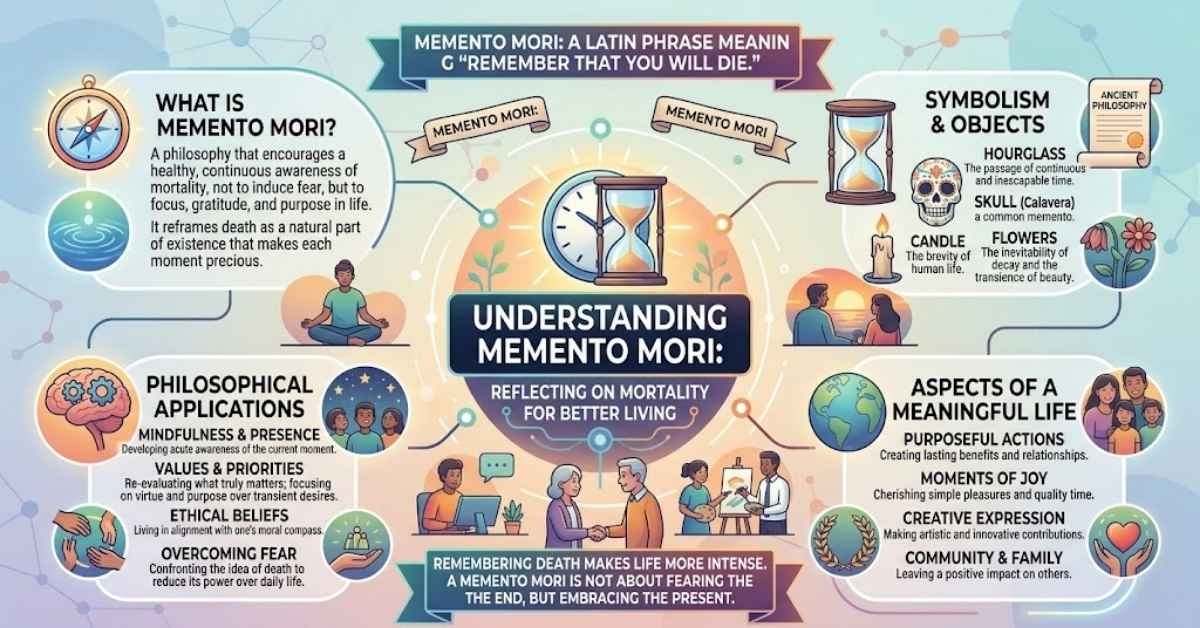
Memento mori meaning is “remember that you must die” or “remember that you will die.” This Latin phrase reminds us that life is temporary and our time is limited. Rather than encouraging fear or sadness, it invites us to appreciate the present, focus on what matters, and stop taking our time for granted.
The idea has influenced ancient philosophy, European art, religious traditions, and modern personal reflection. Today, people use memento mori as a personal motto, a tattoo, a piece of jewelry, or a reminder to live with greater purpose.
Understanding its meaning can help you see why remembering death has often been connected with living a better life.
What Does Memento Mori Mean?
Memento mori is a Latin expression that translates to “remember that you must die.” It is also commonly rendered as “remember you will die.” The phrase serves as a reminder of human mortality, the temporary nature of life, and the importance of using your time wisely.
The expression has two closely related meanings. First, it describes the fact that every human life eventually ends. Second, it refers to a reminder or practice that keeps this reality in mind. A skull in a painting, an hourglass on a desk, or a personal reminder to value your time can all serve as memento mori.
The idea isn’t that you should spend every day thinking about death. Instead, you can acknowledge life’s limits without letting that knowledge control you. When you remember that your time is finite, everyday frustrations may seem smaller, relationships may feel more precious, and long-postponed goals may deserve your attention.
What Is the Literal Translation of Memento Mori?
The phrase comes from Latin. Memento means “remember,” while mori means “to die.” Together, the words form a reminder to remember one’s mortality. Dictionary references also record the expression as a noun for an object intended to remind someone of death. Dictionary.com
In ordinary English, you might express the same idea by saying, “Life is short,” “Don’t take today for granted,” or “Remember that your time is limited.” These phrases capture related ideas, although they aren’t exact translations of the Latin expression.
How Do You Pronounce Memento Mori?
English dictionaries record several accepted pronunciations, including variations in the final vowel sounds. The pronunciation can differ between American and British English. You can consult Dictionary.com’s pronunciation guide to hear the recorded versions.
When speaking about the philosophy, focus less on sounding perfect and more on understanding the idea behind the words.
Where Did Memento Mori Come From?
The idea of remembering death is older than its modern popularity. Ancient Mediterranean cultures used funerary objects, monuments, and imagery to reflect on mortality. Roman traditions and later philosophical teachings also explored the relationship between death, humility, and the way people choose to live.
One famous story connects memento mori with Roman triumphal processions. According to the popular account, someone reminded a victorious general that he was mortal even while the crowd celebrated him. The story illustrates the message well: power, fame, and success cannot make anyone immortal. However, the precise details of this familiar anecdote should not be treated as established historical fact.
Memento Mori in Ancient Rome
Ancient Roman culture included public celebrations of military victories, elaborate funerary customs, and reflections on the limits of human power. The phrase’s Latin roots fit naturally within this world, where reminders of mortality could challenge pride and excessive ambition.
The broader concept also appeared in ancient art. A well-known mosaic from Pompeii combines a skull with objects associated with wealth, power, fortune, and poverty. Its imagery suggests that outward status cannot remove the basic reality of human mortality. The National Museum of Ireland discusses this example and the wider cultural significance of memento mori. Read the museum’s explanation.
Memento Mori in Medieval and Renaissance Art
During the Middle Ages and Renaissance, reminders of death became prominent in European religious art, tomb sculpture, portraits, and still-life paintings. Artists used symbols of passing time and physical decay to encourage viewers to reflect on mortality, worldly possessions, spiritual responsibility, and the limits of human achievement.
Skulls were among the most recognizable symbols. Artists also used hourglasses, extinguished candles, and wilting flowers. These objects could remind viewers that youth, beauty, wealth, and power do not last forever.
The National Gallery’s memento mori glossary explains how skull imagery in European art could represent death as a force that eventually brings worldly accomplishments to an end.
What Does Memento Mori Mean in Stoic Philosophy?
In Stoic philosophy, remembering death is a way to examine your priorities and make better use of the time you have. The practice encourages people to distinguish what they can control from what they cannot, then focus their efforts on their choices, character, and actions.
Stoicism does not teach that life is worthless because it ends. Instead, its ethical teachings emphasize virtue, sound judgment, and living well under circumstances that are not always within your control. The Stanford Encyclopedia of Philosophy’s overview of Stoicism provides scholarly context for these principles.
The Latin expression is often associated with Stoicism today, but an important distinction matters: the broader practice of contemplating mortality appears in ancient philosophical texts, while the exact phrase should not automatically be attributed to every Stoic philosopher.
Marcus Aurelius and Remembering Death
Marcus Aurelius, the Roman emperor and Stoic philosopher, repeatedly reflected on the shortness of life in Meditations. His writing encourages readers to recognize that time is limited and to concentrate on acting well in the present.
Imagine spending years trying to impress people whose opinions you cannot control. A Stoic approach asks whether that effort helps you become a wiser, fairer, or more responsible person. Remembering mortality can help you judge your ambitions by their actual value rather than by the attention they attract.
The lesson isn’t to abandon your goals. It’s to ask whether those goals deserve the time and energy you are giving them.
Seneca and the Value of Time
The Roman Stoic Seneca examined how people waste their limited time through distraction, unnecessary ambition, and endless postponement. In his essay On the Shortness of Life, he argues that people often make life feel short by failing to use it well.
This perspective makes memento mori relevant to ordinary routines. You might spend an evening scrolling through your phone while postponing a meaningful conversation, a personal project, or a long-overdue visit with someone you love.
Mortality awareness doesn’t mean every moment must be productive. Rest, recreation, and simple pleasures have value, too. The point is to make conscious choices instead of allowing your days to disappear through habits you never intended to develop.
Epictetus and Accepting What You Cannot Control
Epictetus emphasized the difference between what depends on us and what does not. Our judgments, intentions, and choices are within our sphere of responsibility, while many external events remain outside our control.
Death is one of life’s unavoidable realities. Remembering that fact can help you focus on how you treat people, respond to difficulties, and use the opportunities available to you.
For example, you cannot guarantee that every relationship will last forever. You can choose to be present, communicate honestly, and show appreciation while the relationship is part of your life.
Memento Mori Symbols and Their Meanings
Memento mori appears in art and everyday objects through symbols associated with death, time, and impermanence. Their meanings depend on the artwork, its historical setting, and the artist’s intentions.1. Skull A skull is the best-known memento mori symbol. It represents mortality and reminds viewers that wealth, beauty, social status, and physical appearance cannot prevent death. 2. Hourglass An hourglass represents the passage of time. As the sand falls, it creates a visual reminder that time continues moving whether or not we pay attention to it. 3. Wilting flowers Flowers can represent youth, beauty, and vitality. When they wilt, they illustrate how even beautiful things change and eventually fade. 4. Extinguished candles A candle that has burned out can symbolize the end of life or the passing of a moment. Its meaning often depends on the religious or artistic context. 5. Mirrors Mirrors can suggest self-reflection, vanity, and the temporary nature of physical appearance. In some artworks, a mirror also serves as a reminder that outward beauty cannot stop time.
These symbols are not universal codes with only one possible meaning. A skull might appear in a memento mori artwork, a religious scene, a scientific illustration, or a modern fashion design. Context determines how the image should be interpreted.
Memento Mori vs. Carpe Diem, Amor Fati, and Vanitas
These expressions are related because they explore how people respond to time, change, and the realities of existence. However, each emphasizes a different idea.
| Concept | Meaning | Main emphasis |
|---|---|---|
| Memento mori | Remember that you will die | Mortality and limited time |
| Carpe diem | Seize the day | Make meaningful use of the present |
| Amor fati | Love your fate | Embrace what happens rather than merely resist it |
| Vanitas | A tradition associated with the vanity and transience of worldly things | The impermanence of possessions, beauty, and status |
Memento Mori vs. Carpe Diem
Memento mori reminds you that life ends. Carpe diem encourages you to make use of the present opportunity. Together, they offer a useful perspective: because your time is limited, the choices you make today matter.
For example, remembering that your parents will not always be around can encourage you to call them instead of repeatedly postponing the conversation. The first idea reminds you of life’s limits; the second encourages you to act.
Memento Mori vs. Amor Fati
Amor fati is commonly translated as “love of fate.” It describes an attitude of accepting and embracing the reality of your circumstances rather than wishing that every difficult event had happened differently.
Memento mori focuses specifically on mortality and life’s limited duration. Amor fati has a broader focus on how you respond to events, including hardship and change. Both can encourage a person to spend less energy resisting unavoidable realities and more energy choosing a constructive response.
Memento Mori vs. Vanitas
Memento mori is the broader concept of remembering mortality. Vanitas is associated with a particular artistic tradition, especially still-life paintings that emphasize the temporary nature of worldly pleasures, possessions, and achievements.
A skull in a painting may serve as a memento mori symbol. When it appears alongside luxury goods, musical instruments, or decaying fruit, the wider composition may also express vanitas themes.
The two concepts overlap, but they are not interchangeable in every historical or artistic context. The National Gallery provides examples of this relationship.
How to Practice Memento Mori in Everyday Life
You do not need a skull on your desk or a daily meditation about death to apply this philosophy. The simplest approach is to remember that your time is limited, then use that awareness to make deliberate choices.
1. Reflect on Your Priorities
Take a few minutes to ask yourself what deserves your attention. Consider whether your daily schedule reflects your actual values or simply your habits and obligations.
You might discover that you spend too much time worrying about minor disagreements while neglecting a creative project or an important relationship. You don’t have to change your entire life at once. Start by making one decision that better reflects what matters to you.
2. Spend Time With People You Love
Relationships are an important place to apply mortality awareness. People change, circumstances shift, and opportunities to spend time together are never unlimited.
Make the call, arrange the visit, express your gratitude, or apologize when you need to. These actions are not valuable because you should expect something bad to happen. They’re valuable because meaningful relationships deserve attention while you can nurture them.
3. Stop Postponing Every Important Goal
Many people wait for the perfect time to begin a project, learn a skill, or make a meaningful change. Memento mori challenges the assumption that time will always be available later.
You don’t need to make impulsive decisions or abandon sensible planning. Instead, identify one goal you’ve repeatedly postponed and take a small, realistic step toward it this week.
4. Practice Gratitude Without Ignoring Difficulties
Remembering mortality can make ordinary experiences feel more valuable. A meal with friends, a peaceful morning, a favorite song, or a conversation with someone you trust may deserve more appreciation than you usually give it.
Gratitude does not require you to pretend that life is easy. You can acknowledge grief, stress, disappointment, and uncertainty while still recognizing what gives your life meaning.
5. Review Your Day
At the end of the day, ask yourself three questions:
- Did I spend my time on something that mattered to me?
- Did I treat the people around me with care and respect?
- What is one thing I would like to do differently tomorrow?
This simple reflection turns an abstract philosophy into a practical habit. You don’t need to answer perfectly. The purpose is to become more aware of your decisions and make gradual improvements.
What Does Memento Mori Mean as a Tattoo?
A memento mori tattoo commonly represents mortality, personal growth, humility, and the desire to live intentionally. Some people choose the Latin words themselves, while others use a skull, an hourglass, a wilted flower, or another image associated with the passage of time.
For one person, the tattoo might serve as a reminder to stop chasing approval. For another, it may express acceptance of life’s impermanence or honor a personal experience that changed their perspective.
The phrase does not have one universal meaning for everyone who wears it. If you’re considering a tattoo, think about what you want it to remind you of personally rather than choosing it only because it looks striking.
LEARN MORE: Holistic Meaning
What Does Memento Mori Mean in Modern Culture?
Today, memento mori appears in jewelry, clothing, books, artwork, personal mottos, and social media discussions about Stoicism. Its appeal comes partly from the contrast between its serious message and the practical freedom it can offer.
A person might keep a small reminder on a desk to stay focused on meaningful work. Someone else might wear a necklace that encourages them to appreciate their relationships or remember a loved one. Artists may use mortality symbols to explore aging, memory, identity, and the temporary nature of beauty.
The idea can be applied without adopting a particular religion or philosophical school. Its central question is straightforward: If your time is limited, what deserves more of your attention today?
That question can encourage ambition without obsession, gratitude without denial, and acceptance without passivity.
Frequently Asked Questions About Memento Mori Meaning
What does memento mori mean in English?
Memento mori means “remember that you must die” or “remember that you will die.” It is a Latin expression that reminds people of their mortality and the temporary nature of life.
Is memento mori a Stoic phrase?
The expression is strongly associated with modern discussions of Stoicism, but the exact Latin wording should be distinguished from the broader ancient practice of contemplating mortality. Stoic philosophers such as Marcus Aurelius, Seneca, and Epictetus explored related ideas in their writings.
Does memento mori mean life is meaningless?
No. The phrase does not necessarily suggest that life lacks meaning. Many interpretations use mortality as a reason to appreciate relationships, act with integrity, and focus on what matters while time remains.
What is the main lesson of memento mori?
Its central lesson is that life is finite, so your time and choices deserve careful attention. Remembering mortality can help you reconsider your priorities and live more deliberately.
What are the most common memento mori symbols?
Common symbols include skulls, skeletons, hourglasses, extinguished candles, and wilting flowers. Their meanings vary according to their historical, artistic, and cultural contexts.
Can memento mori help with everyday decisions?
It can serve as a useful reflection tool. Remembering that your time is limited may help you prioritize relationships, stop postponing meaningful goals, and spend less energy on matters that do not deserve so much attention.
What is the difference between memento mori and carpe diem?
Memento mori means “remember that you will die,” while carpe diem means “seize the day.” The first emphasizes mortality; the second encourages you to make use of the present opportunity.
Why do people wear memento mori jewelry?
People may wear memento mori jewelry as a personal reminder of mortality, a philosophical belief, a meaningful memory, or a commitment to living intentionally. The significance depends on the wearer.
Final Thoughts
The meaning of memento mori reaches beyond its literal translation. It asks you to recognize that time is limited and consider how you want to use it.
You don’t have to become pessimistic, abandon your ambitions, or think about death constantly. You can simply use the idea to appreciate the people around you, act on meaningful goals, and become more deliberate about your choices.
Remembering that life ends can be a reason to live more thoughtfully, not a reason to live in fear.